|
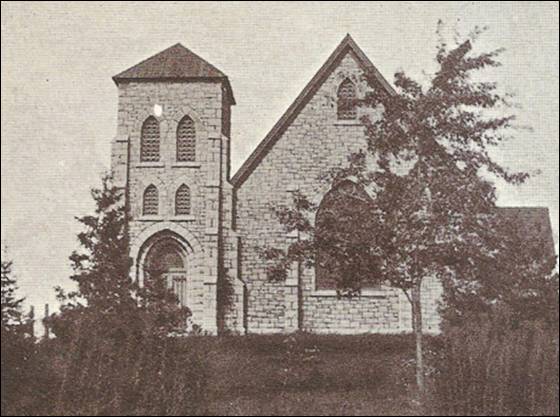
St. Paul’s Presbyterian Church 1907 Photo |
|
History of St. Paul’s (From the Kingston Whig Standard June 23 1951) The Presbyterians of Amherst Island were organized in
a congregation by Rev. Daniel McCurdy 100 years ago. The principal body of
them had emigrated from the County of Down, Scotland and some from the County
Antrim in Ireland, some 20 years previous to this. Many of the settlers being
destitute of Presbyterian ordinances had united with the Episcopal and
Wesleyan churches. Mr. Gilbert Tweedie,
student under the inspection of the Presbytery of Durham and Rev. John McLeise of the Church of Scotland, labored among the
people for some months until Feb. 1852, when Rev. Daniel McCurdy, an ordained
minister from the Presbyterian Church in Nova Scotia was inducted. The first
elders were James Strain, William Patterson and Samuel Girvin. In 1855, Rev. James MacIntosh
became minister and gave the congregation faithful service until 1875 when he
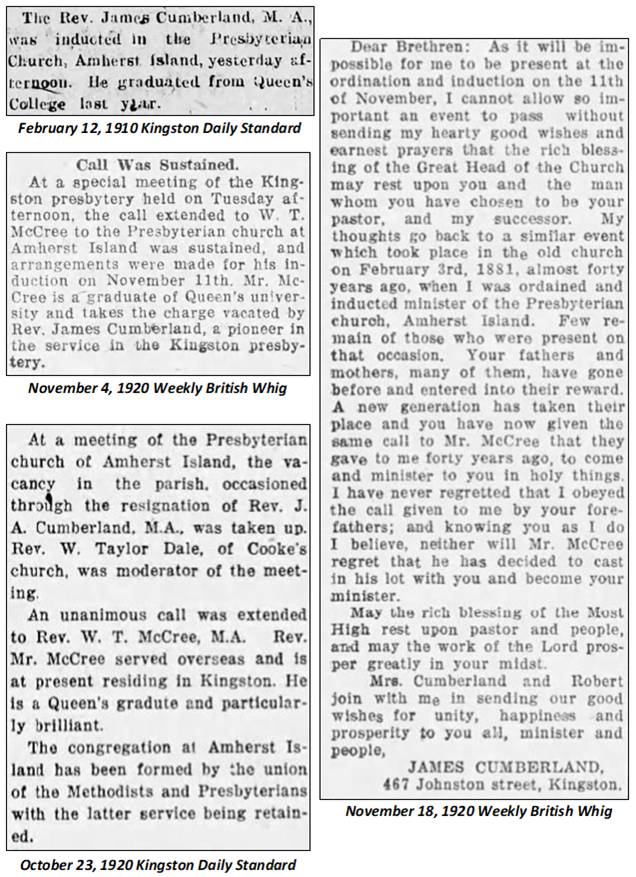
was succeeded by Rev. Howard Steele. In 1881, Rev. James Cumberland, M.A.,
was inducted into the charge and continued as minister until 1920. His 39 years of service at St. Paul’s was
one of the longest and most constructive ministries in this part of Canada. In 1883 the frame church, which with its closed pews
and stoves, had served the congregation for 32 years, was replaced by a
gothic structure of cut limestone. The stone was prepared at the Kingston
Penitentiary and hauled over the ice on sleighs by members and friends of the
congregation. The interior woodwork of alternate oak and cherry adds beauty
to the church. At the rear of the church is a large stained glass window in
memory of Rev. and Mrs. James McLennan, depicting St. Paul and contains the
crest of the Presbyterian Church in Canada, the burning bush. From 1920 to 1932, the congregation was served by
Rev. W.T. McCree, Rev. Robert G. Fry, Rev. S. Hill
and Rev. Vint Laughland.
In 1932, the present minister, Rev. Mr. Earls was appointed. Many changes have taken place in the life of the
community and the church, but the lovely old psalm selections are still sung,
the shorter catechism is still taught. The congregation is thankful for 100
years of God’s guidance blest by memories of faithful kinfolk who have joined
the Church Triumphant. |
|
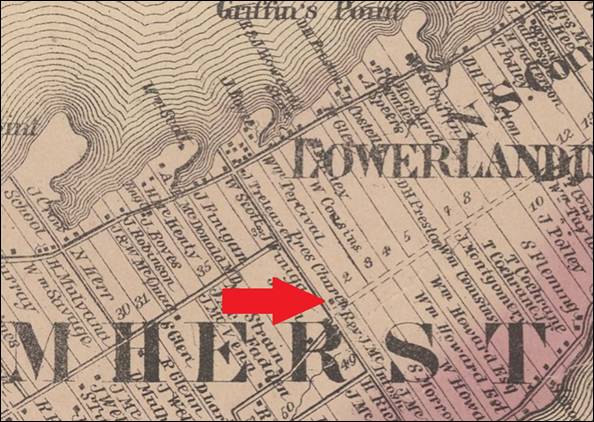
St. Paul’s Presbyterian Church as shown on Wallings’
1860 map Marking the original frame
building which was built in 1851 |
|
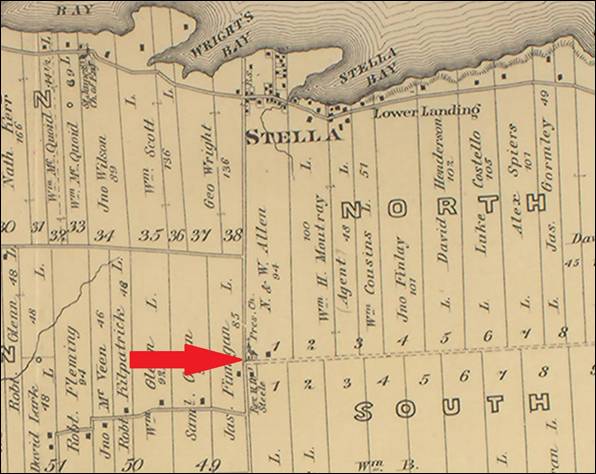
St. Paul’s Presbyterian Church as shown in Meacham’s 1878 Atlas. Marking the original frame
building which was built in 1851 |
|
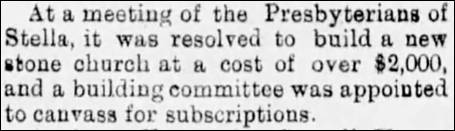
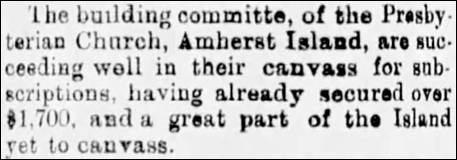
February 11 1882 Daily
British Whig
March 11 1882 Daily British Whig |
|
More History As might be expected a large number of the
inhabitants [of Amherst Island] are Presbyterians; but no regular services
for those of that faith were conducted upon the Island until 1849. The Rev. Mr. McLeise, an
Ulster missionary, cared for the fold of his countrymen for a short time,
holding the services during fair weather in the open air where Glenwood
Cemetery is now. A member of his congregation thus writes of those services:
“From this primitive place of worship, beneath the spreading branches of the
trees, with the green grass for a seat and the firmament for a covering,
there ascended as fervent prayers and praise as from the most stylish
cathedral.” On March 6th, 1832, the congregation was for the first
time duly organized with the Rev. Daniel McCurdy as minister and James
Strain, William Patterson and James Girvin as
ruling elders. No less than seventy-four members were enrolled upon the first
list of communicants. A substantial frame building was soon erected near the
road upon the lot where the church now stands. Mr. McCurdy remained but a
short time and demitted his charge in 1853. After a vacancy of two years, the Rev. James
McIntosh was inducted and for twenty years remained the esteemed and faithful
minister of a devoted and appreciative congregation, who to this day love to
recall the good results of his ministrations. He died in 1875 and over his
grave in Pentland Cemetery, a suitable monument was
erected by his loving friends, among whom he had laboured
until death summoned him to his reward. The Rev. Howard Steele assumed the
charge in 1876 and was followed by the Rev. Alex MacLennan who died in 1880. In the month of February, 1881, the present
incumbent, the Rev. James Cumberland, M.A. was inducted and has the
distinction of having served his congregation longer than any other clergyman
in the county and the esteem in which he is held, not only by the adherents
of his own church, but ay all denominations upon the island, speaks volumes
for his ability as a minister, a kind-hearted gentleman and a public-spirited
citizen. As soon as he was fairly settled among his parishioners, he looked
about for the means of providing a more suitable place of worship. A site was
donated by Mr. William Allen and under the management of Elders William
McMaster, William Fleming and Henry Filson, all of whom have since passed
away, the present church was commenced in 1883 and completed in 1884 at a
cost of $8,000. Robert Kilpatrick, Alexander McKee, David Reid, Wm. McQuain, Robert Filson and Robert Patterson were also
active members of the building committee. Nearby stands the manse built fifty
years ago upon a site donated by Major Maxwell. Mr. Cumberland has taken a
deep interest in the early history of the island and to him I am indebted for the greater part of the material upon
which this chapter is based.” History of the
County of Lennox and Addington, Walter S. Herrington, published 1913 |
|
Church
Dedication Feb
12 1885 Weekly British Whig St. Paul’s Church (Presbyterian), Amherst
Island, was, on Sabbath, Feb. 1st., formally opened and dedicated to the
worship of God. The Methodist church was closed in order that a the good
wishes of the pastor and people might be tendered in person at the opening
services of a sister church and though the day broke with an angry sky and
squalls of snow threatened to make the roads heavy, yet at the hour of
opening the morning service, the church was completely filled and the
officiating clergymen were in attendance from Deseronto and Kingston. A
FINE CHURCH EDIFICE The building deserves more than a passing
notice. It is built of Kingston Limestone, quarried at the penitentiary, and
drawn here by the congregation, who in this labour alone have given $1,500.
It’s style is Maedo-Gothic, with tower and entrance
at right corner and another entrance at front left side. A rose window, with
pendant panels, in size 13 x 8 ft., occupies a central position in the front
wall. This window is in memory of Rev. A. MacLennan and wife (he a former
pastor) and presented by Mrs. Anderson of Kemptville,
Ont., mother of Mrs. MacLennan. The central panel represents the Apostle
Paul, in half life size, with sword and Bible in hand; while the side panels,
suitably engrossed, contains the famous mottoes, “Fight the good fight of
faith,” “lay hold on eternal life.” In the centre of the rose above is the
Burning Bush - honoured symbol of the Presbyterian Church. The whole window
is most beautiful and speaks well for the artistic taste and workmanship of
the maker, Mr. Harwood, of Prescott. Eight gothic windows, six by two with
scripture mottoes, admit light in
sides. Five of these were put in by the Sabbath school and one by Mrs. Craig,
of Deseronto. The back wall is dead, with chimney and
pulpit recess. The ceiling is in panels of stained wood, with exposed
principals resting on corbals. The seats, slightly
curving, are of ash and cherry and are well placed on the floor which
declines towards the pulpit. The dimensions of the interior are 58 ft. long
and 35 ft. broad. The pulpit is neat, made of ash and cherry and modelled
after the most modern style. A high crimson plush, upholstered ash chair
stands behind it. A Boynton coal furnace, placed in the basement, heats the
church. Two pendants, holding eight large lamps, amply light it. Even the roof has not been neglected and
shows conspicuous with its rich brown coat of paint. As we contemplate the
building with its furniture, we can hardly realize that it has cost only
$7,000. When its tower is completed with spire, it will be a gem of church
architecture in its style. The architect was R. Gage, Kingston. The
contractors for mason work were: Robt. Welsh & Son, of Picton;
carpentering, Messrs. Irving & Downs, of Picton. |
|
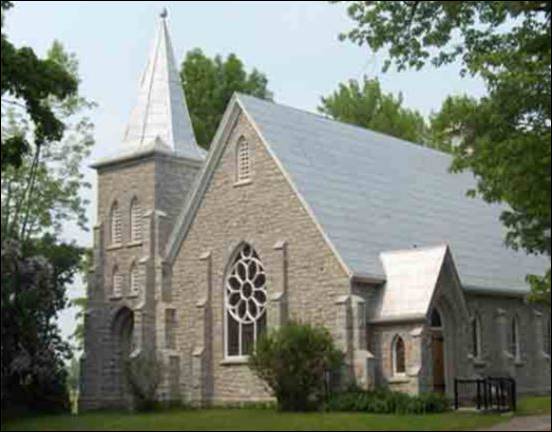
St. Paul’s Presbyterian Church The new limestone building, erected in 1883. |
|
St. Paul’s Donators to the Red Cross Fund St. Paul’s Presbyterian Church, Amherst Island, gave
the Red Cross fund last Sunday for a
bed in a hospital in France, $66. The subscribers are: Joseph Henderson, W.A. Scott, Capt. H. Glen, Robert
Kilpatrick, Robert Caughey, Robert Fleming $5 each. David Caughey, Edward Fleming, Mrs. McMaster, James
Kilpatrick, H.S. Patterson, William Cochrane, $2 each. W.J. Glen, John Glen, William Glen, sr., Joseph A.
Beaubien, John Filson, David Reid, Alexander Reid, James McKee, Frank
Henderson, Robert Cochrane, Alexander McCormack, Thomas Hill, Miss M. Hill,
Mrs. McQuaid, Mrs. William Fleming, Alexander
Beaubien, Thomas Smith, D.H. Filson, T.A. Glen, R.W. Cumberland,
‘No Name, $1 each. Robert Reid, William Glen, jr., Miss G. Glen, Mrs.
Bell, 50c each. June 3 1915
Weekly British Whig The following additional subscriptions to the Red
Cross fund have been given for a second bed by members of St. Paul’s Presbyterian: $3 – Arthur Kilpatrick $2 – Captain H. Saunders, Miss C. Fraser, R.J.
Marshall. $1 – Mrs. William Scott, sr., Mrs. J. Marshall, Miss
A. Glenn, Miss R. Hill, Samuel Fleming, Harris Beaubien, H.S. Patterson, Mrs. J. Miller, Miss E. Spiers. August 2 1915
Kingston Whig Standard Disputes with Presbyterian Church Property Ontario Church Property Commission The church voted against entering the United Church
of Canada. The Session of the charge are asking the commission
to declare that the property passes into the hands of the Presbyterian
Church. At Amherst Island, it was arranged that the morning
service be held in the Presbyterian Church, which is a short distance out of
Stella, and in the evening the worship took place in the Methodist Church,
which is situated on the main street of the village. Since the vote was taken
and the Presbyterians decided to withdraw, the Unionist members of the former
Presbyterian congregation joined up with the Methodists, who also favored
union and have been holding service sin the Methodist Church. The Unionists
are supporting a minister. The Continuing Presbyterians also hold service
each Sunday. Rev. James Cumberland, of Kingston, was for over forty years
minister in the Presbyterian Church. February 25
1926 Kingston Whig Standard Judgment was reserved by the Commission in the case
of the controversy over the Amherst Island churches, where the body who
originally comprised the Methodist congregation are asking for an adjustment
of some $250 for repairs made to the Presbyterian Church. It appears that
here there are two churches, a large stone building, the property of the
Presbyterians and a smaller frame church, the property of the Methodists.
Some six or seven years ago, the two congregations united, worshipping
alternately in both churches, repairs being made to the building from the
general fund contributed by the two congregations. The Methodists claim that
more money was spent on the Presbyterian church for repairs and they ask that
some adjustment be made. February 27
1926 Kingston Daily Standard |
|
|
|
|
For Further
Information:
St.
Paul’s Presbyterian Church Website