|
St. Alban’s Anglican Church (formerly Church of England) |
|
|
|
February 12 1891 Weekly British Whig |
|
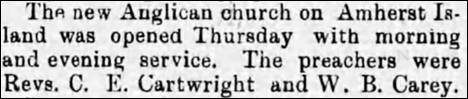
A Fine Country Church It was Dedicated at Amherst Island Last Thursday Feb 12 1891 Weekly British Whig The Services Were Very Bright and Fine – The Contributions to the Erection and Ornamentation of the Beautiful
Sanctuary – The Ceremonies of the Day To erect a church at Stella, instead of the
antiquated structure in the centre of the parish, which once served the whole
island, was a project of no small difficulty owing to the few members of the
church living east of the village and consequently was long talked of before
undertaken, but when at last it was begun, the work was pushed forward with
spirit and celerity, until Thursday, 5th inst., witnessed its
completion, when the event was celebrated with festal demonstrations. First of all, there was the celebration of divine
service in the church at 11 o’clock a.m. The clergy present, besides the Rev.
Wm. Roberts, musical doctor, rector of the parish, were the Rev. Rural Dean
Baker, who took a prominent part in the proceedings, the Rev. Rural Dean
Carey, the Rev. Conway Cartwright, and the Revs. Cooke and Forneri. The
processional hymn having been sung, Rural Dean Baker, turning to the
congregation, pronounced the following words: “We who are here assembled in
the presence of God are now about to set apart this place, in a solemn manner,
for religious worship, designating it by the name of St. Alban, Britain’s
first martyr for the Christian faith.” The rector then proceeded to intone the prayers. The
service was choral throughout. The choir well sustained their parts and sang
with good taste. Rev. C. Cartwright preached from Haggai, ii 9: “The glory of
this latter house shall be greater than of the former, saith
the Lord of Hosts, and in this place will I give peace.” In the course of his
sermon the preacher alluded feelingly to the tender memories connected with
the old church, which they were leaving for this more beautiful edifice. How
many children had there been baptized; how many had there been married; how
many dear ones had been carried there ere they had
been laid to rest in the churchyard. Many years must past ere this new church
became fragrant with such memories as surrounded the old one. A very pleasing part of the service was the solemn
announcement of the various gifts which had been bestowed by the church
members for the embellishment and service of the sanctuary. The following are
the principal of them: The site of the church, from Major Maxwell, the
great landlord of the island, of Groomsport, County
Down, Ireland, the deed of which was handed to Rural Dean Baker. The church itself, unto almighty God for His holy
worship, from the rector and congregation. The altar, which is of antique oak, richly carved,
from Captain C.H. Nicholson, ”in loving memory of his deceased wife.” The marble font, which was set near the west door,
from the rector, “in memory of his three little children, now in Paradise.” Surplice and altar linen, from Miss Olivia Elliott
and the handsome brass lamps, from J. Allan Macdonald. The stained glass memorial windows, which beautify
the interior of the edifice, from the following members of the church: The
east window, consisting of three lights of a geometrical design, in rich and
varied colours, from the family of D.H. Preston, to the memory of a son, a
daughter and a grand-daughter. The west window, also a three light window of
rich and beautiful design, (the centre light contains the figure of “The Good
Shepherd,”) from James Neilson, in memory of his deceased wife; the side
lights, respectively, from Mrs. John Morrow, sr., in memory of her departed
husband and from the McKay family, in memory of their parents. Two of the side windows are also memorial; the one
from Miss A.M. Roberts, in memory of her mother and the other from Mrs. John
Morrow, Jr., in memory of her parents. After each announcement the choir sang the Gloria, and when all the offerings had
been made, Rural Dean Baker invoked a blessing on the several donors. There were many joyful and thankful partakers of the
holy communion which followed, at which the Rev. Rural Dean Baker was
celebrant. After service dinner was served in the town hall and the ladies
were kept more than busy for a time satisfying the hungry. The viands were
excellent and abundant and all present, clergy and people, did ample justice
to the repast. At 7 o’clock p.m., the church was again packed. The
service was choral as before. In addition to the other clergy, the Rev. F.H. Woodcock was present and read
one of the lessons. The rector again intoned the prayers and the singing was
delightful. No one could help feeling the truth of those lines: “How
sweet within thy holy place, With one
accord to sing thy praise;
Beseeching thine attentive ear, With all
the force of fervent prayer.” Rural Dean Carey preached, standing at the chancel steps.
In his own forcible and practical manner he improved the occasion, taking for
his text the words of Jacob, recorded in the xxvii chapter of Genesis and 17th
verse, “This is none other than the house of God, and this is the gate of
heaven.” The preacher showed how the building in which they were assembled,
had “become today, what it was not yesterday, the House of God.” It has been
solemnly presented to almighty God; it had been sanctified by worship; but
above all it had become the habitation of Christ, as the preacher of the
morning had said, “The presence of the Lord Jesus had made it glorious and
holy.” He trusted that the congregation would make it really and wholly God’s
House, by ridding it of debt and by making due use of the worship and ordinances
celebrated therein. Another visit to the hall after session for supper closed
the festivities of this emphatically joyful day for all concerned. The rector
and building committee, who have toiled so unremittingly and so successfully
are to be congratulated on their “work and labour of love,” and also on
everything connected with the celebration. The services were delightful; the
collections were liberal and the ladies efforts in the town hall gave general
satisfaction. The amount realized from all sources was about $80.
The church remains with a debt of a few hundred dollars, which will be
cleared off by degrees. Next summer, as the boats round into the cove of
Stella, the eyes of the passengers will rest upon a sweet little country
church on the bank, rising above the surrounding trees and shrubbery. The
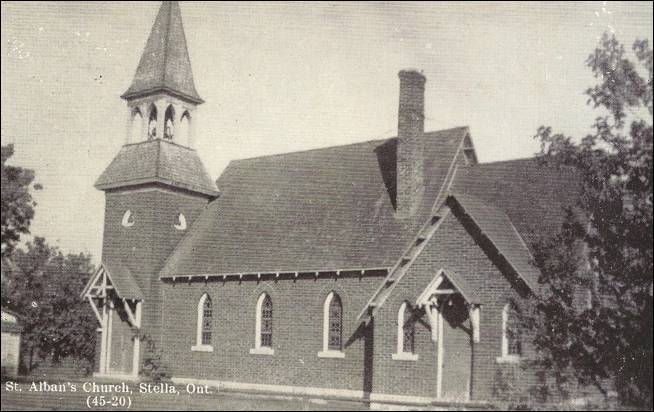
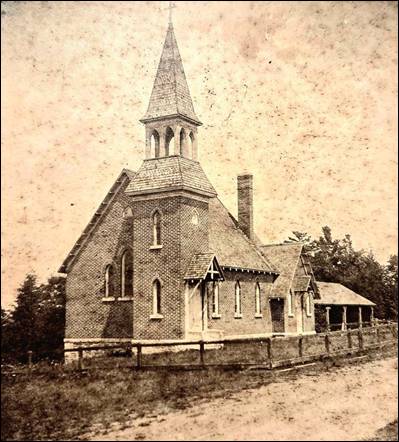
church is gothic in style and is constructed of brick. It stands east and
west thirty feet by twenty-six feet, with a chancel addition of fourteen by
thirteen feet. At the southwest angle a tower eight feet square ascends. It
supports an open belfry, whose steepled roof is
surmounted by a cross. The main entrance door is in the south side of this
tower. The vestry is built against the south wall of the chancel and appears
outside as a gable end with a door in the centre and small gothic windows on
either side, thus giving variety to the design. Inside the ceiling is formed with beaded boarding,
laid diagonally, and some of the roof timers are exposed with fine effect.
The seats and chancel furniture are particularly tasteful and all the
woodwork, which is stained and varnished has a bright and elegant appearance.
The master builder of this church is J. Allan Macdonald, a native and
resident of Amherst island. The islanders may well be proud of having such an
intelligent and efficient mechanic among them. We must not omit the names of the building
committee, who deserve great praise for the intelligence, zeal and energy
with which they have backed up the efforts of their rector. They are: James
Neilson and W. H. Moutray, church wardens; William
H. Preston and J.R. Gibson. |
|
[Another Version of the Opening] Amherst Island Feb 12 1891 Kingston Daily News This picturesque village has received a pleasing and
welcome improvement in the new English church, called St. Alban’s, which has
been just completed and opened for divine service, with appropriate
ceremonies, on Thursday the 5th ult. The day was stormy, but the
people turned out all the same to attend the services, which commenced at 11
o’clock a.m. The rural dean of Lennox and Addington was there from Bath to
take a chief part in the proceedings and Rural Dean Carey from Kingston, who
had consented to preach in the evening. The Rev. Conway Cartwright, who was
announced to preach in the morning, the Revs. A.W. Cooke, R.S. Forneri and
F.H. Woodcock were also present and the rector, of course, the Rev. William
Roberts, Mus. Doc. The service was choral, the choir sustaining their parts
and singing the hymns with excellent taste and expression. A somewhat novel
but interesting feature of the service consisted in the presentation to
almighty God, at His altar, of the numerous articles given by members of the
church for the service or for the adornment of the sanctuary. After each
article was presented, the choir sang a Gloria and after all had been offered, the rural dean
invoked a blessing on the donors. The service over, an adjournment was made to the
town hall, where an excellent repast was served by the ladies of the church,
of which not less than 150 guests partook. In the evening, divine service was again held with
full attendance. Indeed at both services, chairs and benches had to be
provided for the overflowing congregations. The choir, as before, sang sweetly
the beautiful hymn selected from hymns A. and M., and sustained their parts
in the service without a falter. The rector at both service intoned the
prayers. As has been mentioned, the Rev. Conway Cartwright preached in the
morning. He selected for his text Haggai ii. 9, and alluded feelingly to the
affecting associations which were connected with the old church, they had
left the antiquated structure in the centre of the island. In the evening,
the Rev. Rural Dean Carey preached from the text, Gen. xxviii. 17. He urged
his hearers really to make the church the House of God, by freeing it from
debt and by using it – its worship and ministrations. The following is a list of the gifts which were
presented during morning service: The site of the church, from Major Maxwell,
County Down, Ireland, the great landlord of the island. The altar, of antique
oak, paneled and carved, a beautiful object from Capt. C.H. Nicholson, “in
loving memory of his deceased wife,” the marble font which was set near the
west door from the rector, in memory of his three little children, “now in
Paradise.” Surplice and altar linen,
from Miss Olive Elliott and the brass lamps from J. Allan Macdonald. The memorial windows which beautify the interior of
the church, given by the following members of the church were also in their
turn presented, namely: - The chancel or east window of geometrical pattern
is rich in varied colours – a three-light window – from the family of D.H.
Preston in memory of a son, a daughter and a grand-daughter. The west window,
also a three-light window, of beautiful and chaste design and rich colours,
the centre light containing the figure of the “Good Shepherd,” from James
Neilson in memory of his deceased wife. The side lights, respectively, from
Mrs. John Morrow, senior, in memory of her departed husband and the McKay
family, in memory of their parents. Two of the side windows are also
memorials, one erected by Miss A.M. Roberts, in memory of her mother and the
other by Mrs. John Morrow junior, in memory of her parents. The church is built of brick, 40 feet by 36 feet,
with a 14 feet by 15 feet chancel in addition, and a vestry at the chancel
end. A tower at the south-west end rises above the roof and supports a
belfry, which is surmounted by a cross. The main entrance door is in this
tower. The vestry walls are carried up as a gable end and having a door in
the centre and small gothic windows on either side. The roof inside is boarded and some of the beams are
exposed with good effect. The seats and chapel furniture are of tasteful
design and excellent workmanship. The whole interior presents a very elegant
and bright appearance and the entire structure reflects great credit on its
builder, J. Allan Macdonald, Esq., who is a resident of Amherst Island. We must not omit to mention the names of the
building committee. They are: James Neilson and W.H. Moutray,
churchwardens; W.H. Preston and J.R. Gibson. These gentlemen, together with
the rector, the ladies and the congregation in general, are to be
congratulated on the success of their inaugural celebration, the proceeds of
which amounted to $80. We understand that a debt of a few hundred dollars
will remain on the building, to be cleared off by degrees. |
|
|